Showing posts with label mammals. Show all posts

Monday, June 11, 2012

Grizzly Bear


Grizzly Bears (Ursus arctos horribilis) are found in Alaska and Canada with a small population in some northwestern states.  Grizzlys are a subspecies of Brown Bear (Ursus arctos); other Brown Bears are found in EuropeYellowstone's Grizzly Bears are probably the best known in the continental US.

Grizzly Bears are omnivores, eating both plants and animals.  They hibernate in the winter.  They are significantly larger than the Black Bear.  Grizzly attacks on people are rare, but they can be fatal, so it's worth taking safety precautions.  
      
The bear pictured here, drew quite a crowd of spectators at roadside in Yellowstone National Park.


This post is part of series on a Road Trip from Kalamazoo to Wyoming.

Saturday, June 9, 2012

Western deer


Deer are very common in Michigan; I see them in my backyard several times a week.  Our local deer are White-tailed Deer (Odocoileus virginianus).  Out West, the common deer are Mule Deer (Odocoileus hemionus) who have much shorter tails, often with a black tip.  (Mule Deer are sometimes called Black-tailed Deer.)  Mule Deer tend to be bigger than Whitetails. Mule Deer are named for their long ears.


This post is part of a series on a Road Trip from Kalamazoo to Wyoming.

Friday, June 8, 2012

Bighorn Sheep


Bighorn Sheep (Ovis canadensis) were the first animals we saw in Yellowstone, although they weren't easy to see. We stopped at a parking lot where people were looking up at the mountains. Even with binoculars the sheep were difficult to spot since they were so high on a steep slope.


We got much closer to some young Bighorns in Badlands National Park since they were eating grass right at the edge of the road.

The mother shown here is wearing a radio collar, so the Park Service can track her as part of their restoration efforts.

The male Bighorn pictured below lives at the Syracuse zoo. We never got that close to a wild ram (and it's probably a good idea to keep some distance from them.)


This post is part of series on a western Road Trip.

Bison

Bison (Bison bison) or American Buffalo were once widespread throughout the United States.  The eastern part of their range extended from northern Florida to New York State and they were found in all the Midwestern and Great Plains states and up into the western provinces of Canada.  At their peak, their population has been estimated at up to 50 million animals. 

In the 1800s, the vast western bison herds were rapidly exterminated.  Railroads opened access to the west and international markets provided ready buyers for buffalo hides.  By the beginning of the twentieth century, only 2000 bison survived, included a small wild population in Yellowstone.  In 1905, the American Bison Society (led by William Hornaday and Theodore Roosevelt) campaigned to save the bison and to reintroduce them to the wild.  Bison today are considered a "near threatened" species, with about 20,000 bison in conservation herds and over 400,000 in commercial herds.


Buffalo are North America's largest land animal, with males weighing more than a ton.  Their large heads and massive shoulder muscles are adaptations that allow bison to plow through deep snow so they can graze through the winter.  Bison move surprisingly quickly-- over 30 mph.

In the late 1980s, an article sparked a controversial proposal to create a Buffalo Commons in the plains.  
There is currently a movement in congress to make the bison our "national mammal."

See these online resources about bison.


This post is part of a series on a Road Trip from Kalamazoo to Wyoming and back.

Wednesday, June 6, 2012

Moose

Moose (Alces alces or Alces americanus)  are North America's largest deer.  They are widespread in Canada and are also found across the northern part of the continental United States.  A closely related species (or perhaps the same species) occurs in Europe (where it is called the Eurasian Elk, to further the confusion.)

Male moose have broad palmate antlers which are distinct from other members of the deer family.  Moose antlers are shed each winter and replaced by a larger, more elaborate set the next spring.  The male pictured above is probably a yearling, based on his antler development.  In early August, the antlers were still covered with "velvet" which provides nutrients for antler growth.

While some moose live in Michigan's Upper Peninsula, we saw these in Wyoming.

This post is part of a special Road Trip series.       

Tuesday, June 5, 2012

Pronghorn

Pronghorns (Antilocapra americana) are America's fastest land animal.  While they look superficially like deer, they are more closely related to antelopes.  Instead of antlers, both males and females have horns with a bone core.  The males' horns are larger.  Unlike deer, Pronghorns are poor jumpers which makes fences a problem for them, particular during migration.  Like deer, Pronghorns have a split hoof with two distinct toes.

Pronghorns are natives of the Great Plains and their range is restricted to the Western US and Canada.  At its peak, the Pronghorn population numbered in the millions.  Overhunting, and changes in land use, caused a population crash; by the 1920s, only around 26,000 Pronghorn remained.  Conservation efforts by State and Federal governments, supported by hunting organizations, allowed the population to rebound.  Efforts to protect the Pronghorn continue today.


This post is part of a Road Trip series

Prairie Dog


Prairie Dogs (Cynomys ludovicianus) are a ground squirrel of the shortgrass prairie.  They are social animals who form colonies called "towns" that can cover hundreds of acres. Prairie dogs warn their neighbors of danger with a bark-like call.  This "bark" gives them their common name.

Ranchers' belief that prairie dogs competed with cattle for grass led to a series of policies to eradicate prairies dogs, including widespread poisoning.  These policies led to a drastic reduction in prairie dog numbers.  More recent studies suggest Prairie dog colonies can have a positive impact on grazing lands.  For details, see this history of prairie dog policy [pdf].


This post is part of a Road Trip series.

Thursday, May 17, 2012

Muskrat baby

Muskrats (Ondatra zibethicus) in the north have their first litter in late April or early May.  At birth, they are nearly hairless and blind, so they spend their first two weeks in their den.  We saw this one last weekend, so it was probably on one of its first outings.

Muskrats are widely distributed in the United States and Canada and have been introduced in other countries because of the value of their fur. Muskrats aren't really a rat; behaviorally, they are similar to a beaver-- spending most of their time in the water and building lodges and dens.  (Smithsonian says they are also called Muskbeavers, which would be a better name but I've never heard anyone use it.)
 

Sunday, November 13, 2011

Black Squirrel


Black squirrels are a color morph of the Eastern Grey Squirrel (Sciurus carolinensis) which is widely distributed throughout the Eastern United States and Canada. The black variety is relatively rare, with localized populations becoming something of a tourist attraction. Southern Ontario and Michigan seem to have relatively large numbers of black squirrels. Legend says W.K. Kellogg brought black squirrels to the area. (Personally, I'm somewhat skeptical of this; black squirrels seem too broadly distributed in the area to have come from a single source.)

My backyard is full of Fox Squirrels, Red Squirrels, and Chipmunks so I never see Grey Squirrels (of whatever color) in my yard. But, a few miles south in Portage (near Centre Avenue) I always see black squirrels. The squirrel pictured here was at Portage's West Lake Nature Preserve.


See also: Myths and Realities of the Mysterious Black Squirrel
Michigan's Squirrels
Information on many Squirrel species

Sunday, October 2, 2011

Red Squirrel


Red Squirrels (Tamiasciurus hudsonicus) are much smaller than the other squirrels I see around Kalamazoo. (Flying squirrels are even smaller but since they are nocturnal I hardly ever see them.) Red Squirrels also quicker than the Fox Squirrels and, for some reason, more charismatic.

Now they are busy filling their caches with food. While they aren't true hibernators, I don't remember seeing them during the winter. Perhaps they're spending the cold months in their nests enjoying their stored harvest.

Sunday, January 2, 2011

Night visitor


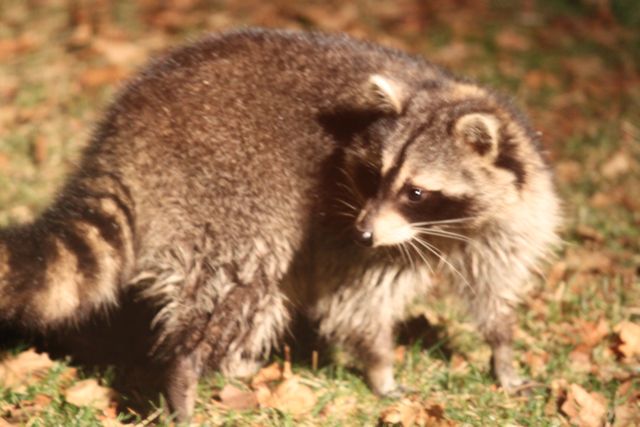
Just past the winter solstice, Michigan has about six hours less daylight than it does in mid-summer, so it can can feel pretty dark and gloomy. For nocturnal animals, the long night means more overlap with people. On New Year's Day, this raccoon (Procyon lotor) was in my backyard during dinner.

Thursday, December 16, 2010

Snow tunnel


While field mice and voles are difficult to see in the wild during the summer, in the winter it can be easy to find their snow tunnels. Unlike the chipmunk or the woodchuck, these small mammals stay active all winter, building systems of tunnels under the snow. When the snow is shallow, like it was this week, the tracks are visible.

Sunday, April 18, 2010

Groundhog Day


While the calendar shows Groundhog Day on February 2, in Kalamazoo the groundhogs sleep for another couple of months. Our backyard woodchuck (Marmota monax) reappeared yesterday. Unlike their cousins, woodchucks are true hibernators sleeping through the entire winter.

Thursday, March 18, 2010

Awake to Spring


Kalamazoo's chipmunks (Tamias striatus) may not be true hibernators, but they've just emerged from their burrows, where they spent the winter alternating between a deep sleep called torpor and eating stored food. Their relatives, the fox squirrels, were active all winter. Their woodchuck cousins are still underground.

Sunday, January 10, 2010

Squirrel-proof feeder?

Deer can eat a lot of birdseed quickly, but they're interesting to watch. They only visit my feeders at night.

Thursday, January 15, 2009

Cold

As I write this, it's -3° (-20° C) in Kalamazoo. Even the wildlife looks cold. Of course, its much colder on the other side of Lake Michigan.

Sunday, December 14, 2008

Backyard wildlife

For some reason, we see more animals in the yard during the winter. I'm not sure if it comes from seasonal changes in their behavior or in ours. We've seen deer every morning this week and an opossum last night.